


SEND Provision
Our aim is to embrace the needs of all students and have a whole-school approach to Special Educational Needs and Disabilities (SEND).
We provide effective opportunities for all students by responding to students’ diverse and often complex, learning needs, setting suitable learning challenges and overcoming barriers to learning and work closely with the pastoral team to support students.
Tring is an inclusive school that believes strongly that all students, regardless of ability, background or ethnicity, have the right to participate in and enjoy all aspects of school life, including access to a full curriculum and have the opportunity to meet their full potential. Tring School recognises the definition of SEND as described in the SEND Code of Practice 0 to 25 years, September 2014.

 The role of the Learning Support Department is to aid the learning and progress of students with special educational needs and disabilities, and to help remove any barriers to learning that they might experience.
The main objective of the SEN provision is to assist any child who has a special educational need or disability which is affecting their progress at school. The support for students with SEND is coordinated by the school’s SENCo (Special Educational Needs and Disabilities Coordinator). It is their job, in conjunction with other SEND team members and the pastoral team, to ensure that students with barriers to learning are identified, appropriate interventions implemented and their progress reviewed on a regular basis, where appropriate.
Interventions
At Tring School we recognise that students make progress at varying rates. At times they may need extra support to help them overcome a hurdle or a problem to help their learning. We identify students who need further support through class teacher referrals and in school testing.
SEND Information Report 2025/2026 (pdf available in the folder at the end of this page)
SEND Policies & documents are in the folder at the end of this page
|
|
|
|
|
|
|
General Enquiries |


"The needs of pupils with SEND are accurately identified. Appropriate specialist support is put in place when required." Ofsted Report May 2023
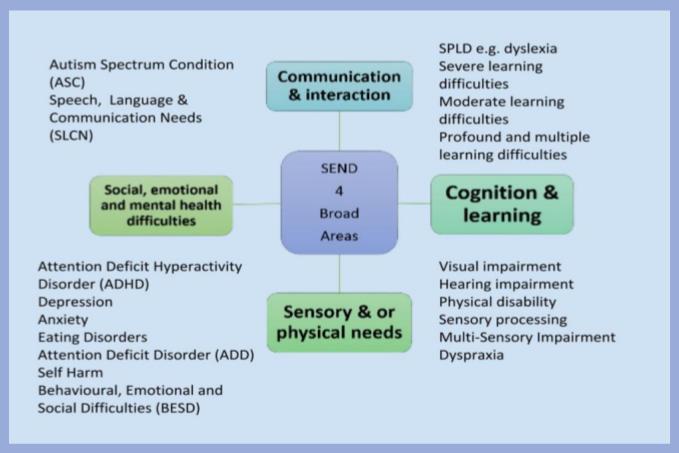
Four Broad Areas of Need
When a child is identified as having SEN (Special Educational Needs), schools use four broad categories to identify the kind of support they need. Think of these categories not as rigid boxes, but as a roadmap to help teachers target the right areas.
It is incredibly common for a child to have needs that overlap across two or more of these areas. The goal of these categories is to make sure the school provides the exact tools, environment, and teaching style they need to thrive.
Local Offer
The Local Offer lets parents and young people know what special educational needs and disabilities services are available, and who can access them.
Coffee Mornings/Surgeries
Copies of slideshows shown during our parent/carer events can be found below. Please click the three vertical dots to right of the page number to open the options menu and enter full screen.
4 March 2026 | Parental Engagement Evening
5 February 2026 | Surgery Drop In
October 2025 | Year 7 Coffee Morning
October 2025 | Years 8 & 9 Coffee Morning
October 2025 | Years 10 & 11 Coffee Morning
July 2025 | Surgery Drop In
EBSNA (emotionally based school non-attendance)
EBSNA is a term used by schools and psychologists to describe a child who wants to go to school but feels physically and emotionally unable to do so because of severe anxiety or distress. We have support in place to help families and young people who are struggling with EBSNA.
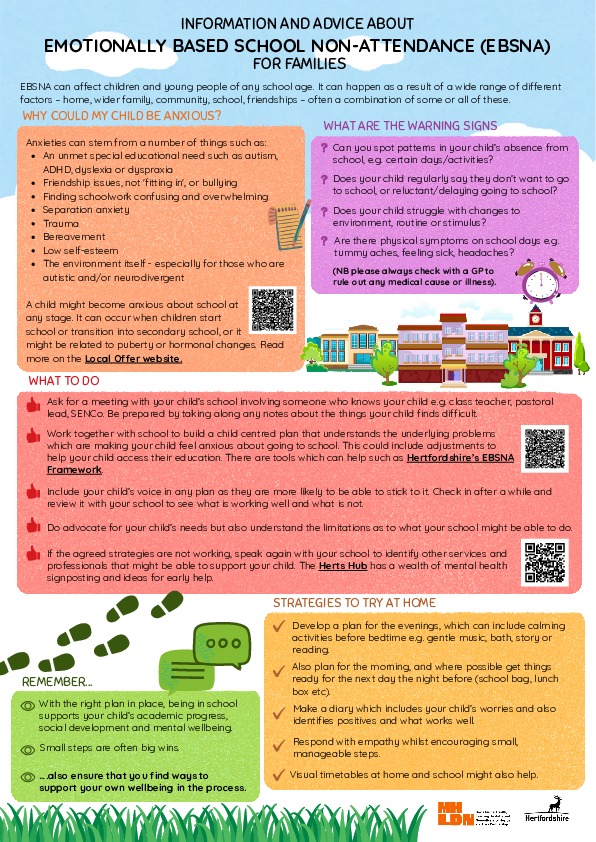
PDF copy available in the folder at the end of this page.
Exam Access Arrangements (EAA)
Some students may need extra support during exams
Students who the school feel may benefit from additional support during exams are tested in school to ascertain the type of support which would be most appropriate. Even though students may have had access to support during their KS2 studies, it does not mean that it will automatically be the case at KS3 or GCSE. The school has to retest at each Key Stage as required by the exam boards. The school will test a student if:
- They have previously accessed exam support at KS2
- Their teacher(s) makes a referral to Learning Support with concerns about the student
- There is significant evidence from classroom-based assessments that a student needs support during tests
Once a student has been assessed, the school will contact parents with any recommendations. This may be one or more of the following special exam access arrangements: Use of ICT, reader, scribe, rest breaks, extra time, prompt.
Please note that although we will take into consideration a private educational psychologist report about exam access arrangements, we may not apply to the exam boards with their recommendations. Instead, we have a qualified tester in school, and we will use their recommendations about how best to support a student in exams.
Our Exam Access Arrangements and Exam Policy can be found in the folder at the end of this page.
Find fun, inclusive activities your child will love – all in one place!
Are you looking for local activities and SEND services for a child or young person with SEND?
The SEND community activities directory promotes a wide range of local activities and support groups. Some activities will also include discounts for families registered with a Herts Card (SEND).
Use this link to explore the SEND community directory.
We will be adding additional activities on a regular basis.
If there are any activities you know of or wish to see promoted through this directory please email us on: SENDcommissioning@hertfordshire.gov.uk
Useful Websites
Ambitious about Autism & National Autistic Society: Essential hubs for autism-specific strategies, rights in education, and transition-to-adulthood support.
Cerebra provides help to support parents/carers with children who have sleep issues. They also have a stress helpline.
Contact: A major charity providing comprehensive advice on legal rights, disability benefits (DLA/PIP), medical conditions, social care, and family wellbeing.
Council for Disabled Children: Brings together policy updates, resources, and easy-read guides explaining the legal rights of children and young people with SEND.
IPSEA (Independent Provider of Special Education Advice): The gold standard for legally-based SEND education advice. Features downloadable template letters, guidance on EHCPs (Education, Health and Care Plans), and tribunal support.
Kids.org - Young People’s Inclusion Network – offers a wide range of services across the country and SEND advice.
Mencap supports people with a learning disability and their families and carers.
Mental Health Foundation has on-line information about anxiety, depression, ADHD.
Neuroinclusive Education Network - formerly The Autism Education Trust (AET) is part of the National Autistic Society.
Preparing for Adulthood provides expertise and support for preparing for adulthood from the earliest years.
SOS!SEN: An independent charity offering a helpline, downloadable legal guides, and workshops to help parents navigate special education needs law and EHCP processes.
Special Needs Jungle: A widely trusted parent-led site providing practical advice, news, resources, and step-by-step guides for navigating the SEND system.
Young Minds is a national charity committed to improving the mental health of all children, advice about depression, eating disorders, and other mental health issues affecting children, see website for details.
Hertfordshire Specific Websites
- Hertfordshire SEND Local Offer: The official county directory outlining local educational support, NHS therapies, short breaks, and local authority processes.
- ADD-vance is a Hertfordshire based charity that supports families affected by ADHD, Autism or a related condition and the professionals who support them.
- Hertfordshire community NHS Trust - Speech and language therapy
- Herts SENDIASS: Delivers free, confidential, and impartial legal information, advice, and support specifically regarding SEND processes within Hertfordshire.
- Herts Parent Carer Involvement (HPCI): An independent parent carer forum working alongside local health and care services to improve SEND provision across the county.
- SPACE Hertfordshire: A local charity supporting families of neurodivergent children (Autism, ADHD, Dyspraxia). Offers workshops, support groups, and leisure activities.
Buckinghamshire Specific Websites
- Buckinghamshire SEND Local Offer: The central hub for local SEND provision, containing health and social care services, local school options, and the Bucks Autism Toolbox.
- NHS Buckinghamshire healthcare speech and language
- Bucks SENDIAS: Provides impartial advice, support with EHCP reviews, and representation for Buckinghamshire families.
- FACT Bucks: The official Parent Carer Forum for Buckinghamshire, giving parents a voice in shaping local SEND services and offering peer network connections.
- Autism Early Support - Parent's Portal: A Buckinghamshire-commissioned platform offering guidance, training, and resources for families navigating neurodiversity.
-
SEND Provision